
The Prime: Six Points in a Row
Can you block six points in a row? It's one of the most common arguments over the board, and the answer depends on the game. In backgammon a full prime is legal and powerful; in long nardy there's a special rule against it.
Play for freeNo sign-up, no download — right in your browser
What a prime is
A prime (also called a block or a wall) is a run of consecutive points you hold. In backgammon a point is "held" when you have two or more checkers on it; in long nardy a single checker is enough, because nothing is ever hit and no checker may land on an opponent's point. Six points in a row are a wall nothing can cross: no die shows more than six.
Backgammon: the full prime is legal
Backgammon has no blocking rule. A six-point prime is a legal and very strong formation: every opposing checker behind it is stuck until you choose to break it. The dream position is a closed board — all six points of your home board held — while an opponent's checker sits on the bar. It can't enter at all, so your opponent loses turn after turn (see bar rules and the odds of entering).
Building a prime takes time, so in practice players aim for four or five points first, ideally right in front of the opponent's back checkers. How to get there is covered in backgammon strategy.
Long nardy: the six-point block rule
Because one checker already closes a point in long nardy, a six-point wall would be too easy to build and would end the game as a contest. So the rules say:
- You may not hold six points in a row if none of your opponent's checkers has got past that row yet.
- You may, once at least one opposing checker is ahead of the wall, closer to its own home.
- Five in a row is always allowed.
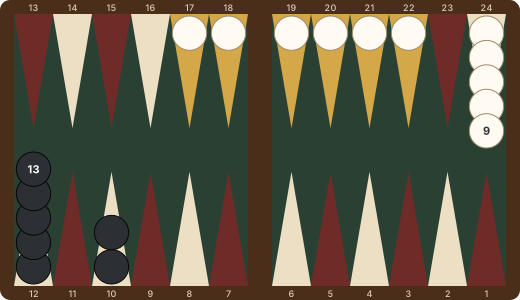
The point of the rule is to stop one player locking the other in completely. If even one opposing checker is through, your opponent still has something to move, and the ban is no longer needed. The full rules are in long nardy rules.
Closing your home board in long nardy
Your home board is six points in a row, and in long nardy your opponent's checkers pass through it on their way round. So the same rule applies: while all of their checkers are still behind your home board, you can't fill all six points — one gap has to stay open. Once one of their checkers is past, you can close it. This usually comes up near the end of the game, while you're bringing checkers home.
When the only legal move would make a banned block
A banned move counts as an impossible one. If a number can only be played by forming an illegal six-point block, that number isn't played. The normal rules then apply: if only one die can be used, you play that one; if neither, your turn passes. More on this in what if you can't move.
Using the block in play
- Five in a row is the maximum in long nardy while no opposing checker has passed — and a five-point wall right in front of their checkers takes away almost all of their rolls.
- Watch the opponent's checkers. As soon as one gets past your wall, the sixth point becomes legal.
- Don't count on the sixth checker. If the sixth point is banned, a plan built on it collapses — check where your numbers will go.
On NARDEON the game enforces the rule itself: an illegal block simply can't be made, and the highlights show where you can go. More block ideas are in long nardy strategy.
Play for freeNo sign-up, no download — right in your browser
FAQ
What is a prime in backgammon?
Several consecutive points held by one player (two or more checkers each in backgammon). A six-point prime is a wall no checker can jump, because no die shows more than six.
Is a six-point prime legal in backgammon?
Yes. There's no limit in backgammon: a full prime traps every checker behind it until you open it.
Can you block six points in long nardy?
Only if at least one of your opponent's checkers is already ahead of the wall. While all of their checkers are behind it, five in a row is the maximum.
Does the rule apply across the two halves of the board?
Yes. The six points are counted along the opponent's path, so a wall that turns the corner from one half to the other is banned the same way.
Updated: October 25, 2026