
The Head Rule in Long Nardy
The head is the point where all 15 of a player's checkers start in long nardy. The head rule — one checker off the head per turn — is what makes the game slow and positional, and it's the rule backgammon players trip over first.
Play for freeNo sign-up, no download — right in your browser
The head is the point where all 15 checkers stand at the start of a game of long nardy: White's in the top right corner, Black's in the bottom left (seen from White's side). "Taking a checker off the head" means moving a checker from that point.
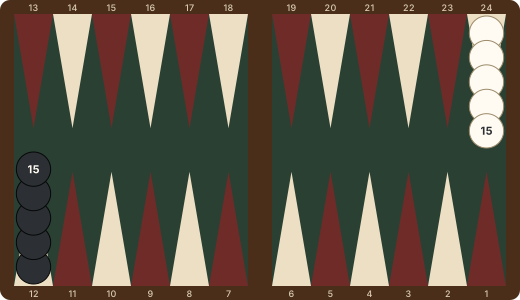
The main rule: one checker off the head per turn
In one turn, only one checker may leave the head — whatever you rolled: 6-5, 2-1 or a double. The other numbers are played with checkers already on the board, or with the same checker that just left the head.
- 5-3. Take a checker off and move it 5, then 3 (8 in total). Or move it 5 and play the 3 with another checker, if you already have one in play.
- 4-4 in mid-game. One checker off the head; the other three fours with checkers on the board or with the same checker further on.
- Nothing to move. If a number can't be played by the checker that left the head or by any other checker on the board, it's lost — you don't take a second checker off the head for it.
The exception: your first turn with 6-6, 4-4 or 3-3
On your first turn of the game, if you roll 6-6, 4-4 or 3-3, you may take two checkers off the head. The reason is the opponent's head: it stands right in the path, and one checker can't play the whole double.
| First roll | Off the head | What happens |
|---|---|---|
| 6-6 | 2 checkers | Both go to the 18-point; the other two sixes can't be played — the opponent's head is in the way |
| 4-4 | 2 checkers | Each moves two fours — both land on the 16-point |
| 3-3 | 2 checkers | Four threes split between two checkers: e.g. both to the 18-point, or one to the 15 and one to the 21 |
| 5-5, 2-2, 1-1 | 1 checker | One checker can play all four steps, so no exception is needed |
| Not a double | 1 checker | As usual |
Points are counted from your side: 1 is the first point of your home board, 24 is your head. On NARDEON, point numbers on the board frame can be switched on in Settings. The exception applies only to each player's first turn — a 6-6 on your second or tenth turn means one checker again. More on doubles: doubles rules.
Why the head rule matters
The head rule makes long nardy a slow, positional game. Emptying the head takes at least 14 turns (15 checkers, and at most two on the first turn). So every turn you decide whether to bring a new checker off the head or move the ones already out. Checkers stuck on the head spend the rest of the game catching up, and your opponent will happily occupy the points just past your head to make leaving harder. How to use this is in long nardy strategy.
Common mistakes
- Two checkers with an ordinary double. 5-5 on the first turn tempts you to take two — you can't.
- Two checkers on the second turn. The exception is for the first turn of the game only.
- "A checker from the head can only move one number." No — it can play both numbers if the point in between isn't held by the opponent.
- Mixing it up with backgammon. Backgammon has no head; its own rules apply — see long nardy vs backgammon.
How NARDEON handles it
The game enforces the head rule itself. If you've already taken a checker off the head and try to take another, the game won't let you and tells you why. On the first turn with 6-6, 4-4 or 3-3 it allows the second checker. All the rules in order are in long nardy rules.
Play for freeNo sign-up, no download — right in your browser
FAQ
How many checkers can leave the head in one turn?
One. The only exception is your very first turn of the game with 6-6, 4-4 or 3-3, when two checkers may leave.
Can the checker that left the head play both numbers?
Yes. It can move one number and then the other, as long as the point in between isn't occupied by the opponent.
Why are 6-6, 4-4 and 3-3 special on the first roll?
With these doubles one checker can't play the whole roll: the opponent's head is in the way. So the rules let two checkers leave.
Is there a head in backgammon?
No. In backgammon the checkers start spread over four points, and there's no head rule.
Updated: October 25, 2026